Architecture
Overview
The Polymesh blockchain is optimised for regulated assets and markets. This is reflected in its approach to governance, security and consensus, as well as the base layer primitives provided directly by the network for asset origination and lifecycle management.
Polymesh is a public, permissioned blockchain. This means that anyone can run a node and check that the rules enforced by the network are being followed by all participants, and see all the public state secured by the blockchain, but that only certain entities (called operators) are allowed to run nodes that author new blocks, and vote on the finality of other blocks.
Polymesh is built on the Substrate framework, an open-source project, developed by by Parity, that provides a fully customisable, modular and extendable framework for blockchain developers.
Polymesh has a native token, used for security and payments, POLYX.
Polymesh provides core business logic and financial abstractions at its base layer, called primitives. These provide a rich set of embedded on-chain actions (called extrinsics) that a user can initiate, such as creating an asset, settling securities instructions or participating in on-chain governance.
Polymesh also supports Layer 2 Smart Contract logic via pallet-revive, allowing network users to extend and leverage the base layer primitives to build on-chain financial and identity based protocols. Polymesh smart contracts execute on PolkaVM, a RISC-V based execution engine, with EVM compatibility (Solidity contracts, standard Ethereum JSON-RPC tooling) supported as one interface into the same pallet rather than a separate system.
Architecture
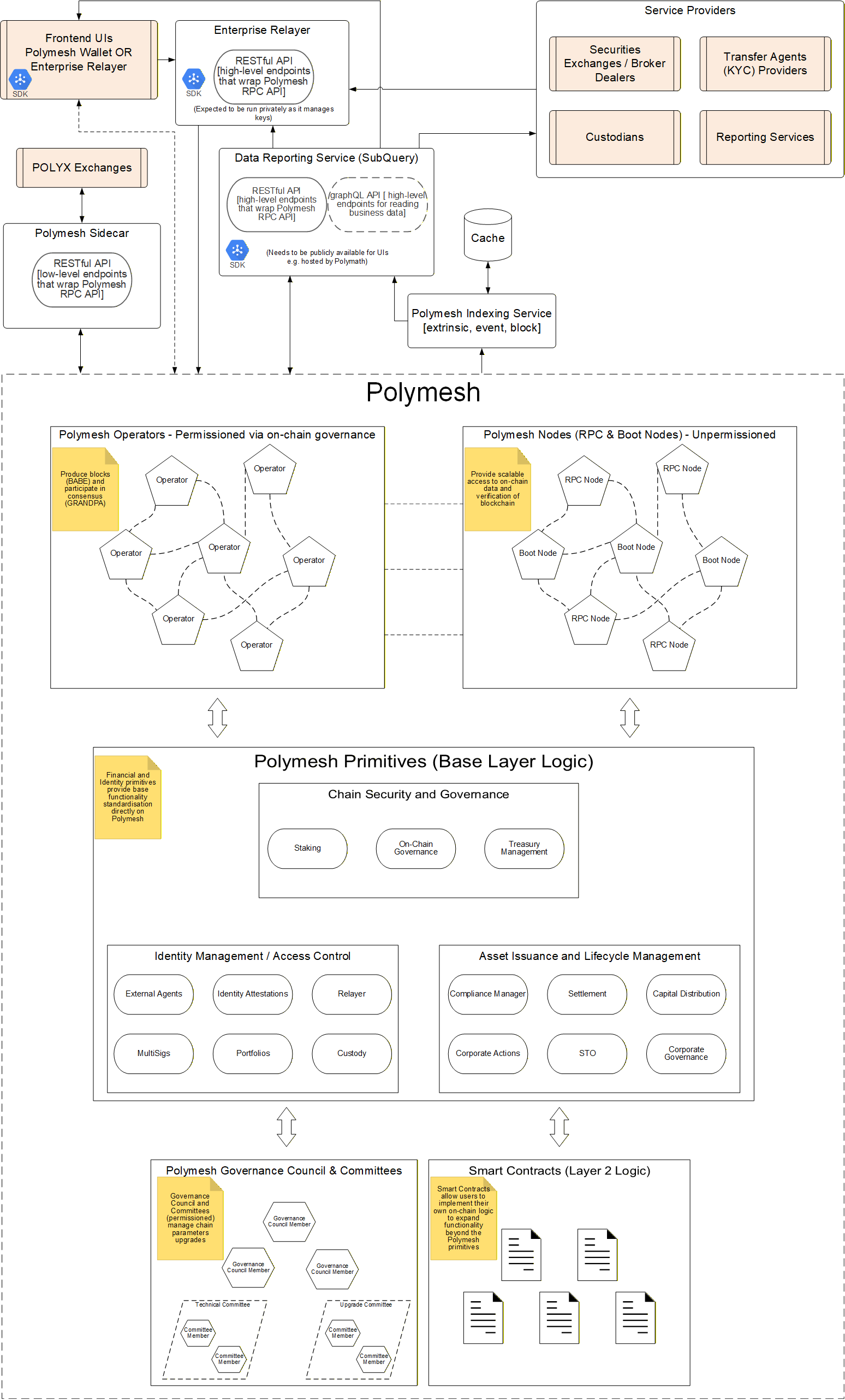
Polymesh and Polymesh Private
While Polymesh is a public-permissioned blockchain, Polymesh Private is a variant designed for deployment as a private blockchain among participating chain operators. There is a single Polymesh mainnet, but there can be many independent instances of Polymesh Private chains.
Polymesh Private shares much of Polymesh's functionality, with the following differences:
- Polymesh Private chains are intended to run among a limited set of peers on a private network.
- Polymesh Private does not use the POLYX token. While transactions may still incur fees, they are paid in a token specific to each Polymesh Private instance, which is not expected to have intrinsic value. Alternatively, Polymesh Private transactions can be configured to have no fees.
- The use of Polymesh Private is governed by a license; see the Polymesh Private license details for more information.
Polymesh Pillars
Polymesh is tailored to the needs of regulated assets and global capital markets. This approach is guided by the four key pillars of Polymesh - Identity, Governance, Confidentiality and Compliance.
Identity
Identity is at the core of Polymesh. Polymesh uses DID-based onboarding where users can self-register a DID or use a permissioned DID registrar to assign a DID. Identity and asset related transactions in Polymesh require an on-chain identity, represented by a DID.
Identities provide attestation and key management. All users must act through an on-chain identity when interacting with identity and asset related transactions on Polymesh. Identities are referenced through DIDs (decentralised identifiers).
Identity attestations allow asset issuers to enforce compliance on-chain in real-time as assets are issued, traded and settled between different parties.
Identity key management allows users and organisations to flexibly manage their on-chain identities via primary and secondary keys and delegate asset management to other identities via external agent functionality.
An entity (a real world individual or organisation) can have multiple on-chain identities, allowing them to keep their overall positions segregated and confidential.
Governance
Governance allows the chain to grow and develop. Polymesh has a sophisticated governance mechanism that combines signals from the broader community with technical experts (committees) and a governing council for actioning proposals. Polymesh Improvement Proposals (PIPs) can be proposed by any network user, and possible PIPs include network upgrades, setting the parameters of the network related to consensus and security and many other actions.
The Polymesh governance system is designed to further decentralise over time.
Confidentiality
Confidentiality allows Polymesh users to maintain privacy over certain aspects of their securities transactions. The Confidential Assets pallet is designed to allow confidentiality within asset transfers using zero-knowledge proofs, while still supporting regulated-market workflows such as receiver affirmation and asset-specific auditor/mediator compliance access. It is live on Testnet as a pre-release feature and not yet available on Mainnet.
Compliance
Polymesh facilitates claim based compliance directly in its base layer primitives. Asset issuers can set flexible and extendable rules relating to the claims that their investors are required to have attached to their identity in order to either send or receive the asset. These rules can be combined to create complex transfer restrictions that are tailored to the assets specific type, jurisdiction and regulatory regime.
Consensus
Polymesh provides financial primitives and business logic, built on top of a distributed storage ledger.
Updates to the ledger are processed across a decentralised network of Polymesh operator nodes. The consensus mechanism consists of three main components:
-
Operator Selection: Nominated Proof-of-Stake (NPoS) determines which permissioned operators will actively participate in block production and finalization. In this system:
- Node Operators (validators) indicate their intention to submit blocks and make their candidacy public
- Token holders participate as nominators by staking POLYX tokens behind operators they trust
- The network through the election algorithm distributes staked tokens to maximize economic security
- Operators with the highest backing are elected as active validators
- Both operators and nominators (currently disabled) face risk of slashing (loss of staked tokens) for operator misbehavior
-
Block Production: Elected operators participate in BABE (Blind Assignment for Blockchain Extension), which determines which operator can produce blocks in each time slot
-
Block Finality: These same operators also participate in GRANDPA (GHOST-based Recursive ANcestor Deriving Prefix Agreement), which provides rapid finality by having operators vote on chains rather than individual blocks
Polymesh is a permissioned network, and in order to run an operator node, the associated identity must first be permissioned through an on-chain governance process. These operators are typically regulated or licensed entities in their home jurisdiction, adding an additional layer of security through real-world accountability.
For more details on Consensus see: